KEY PROBLEM
PROJECT 02 · GAME AI · SEARCH · POLICY EVALUATION
PokéMind
A reproducible framework for building, evaluating, and rejecting agents for strategic card battles.
V4submission champion
THE SYSTEM
PokéMind began with hand-written heuristics and evolved through forward search, replay imitation, adversarial evaluation, on-policy evolution, and counterfactual action-value learning. The central artifact is the evaluation process—not a single model.
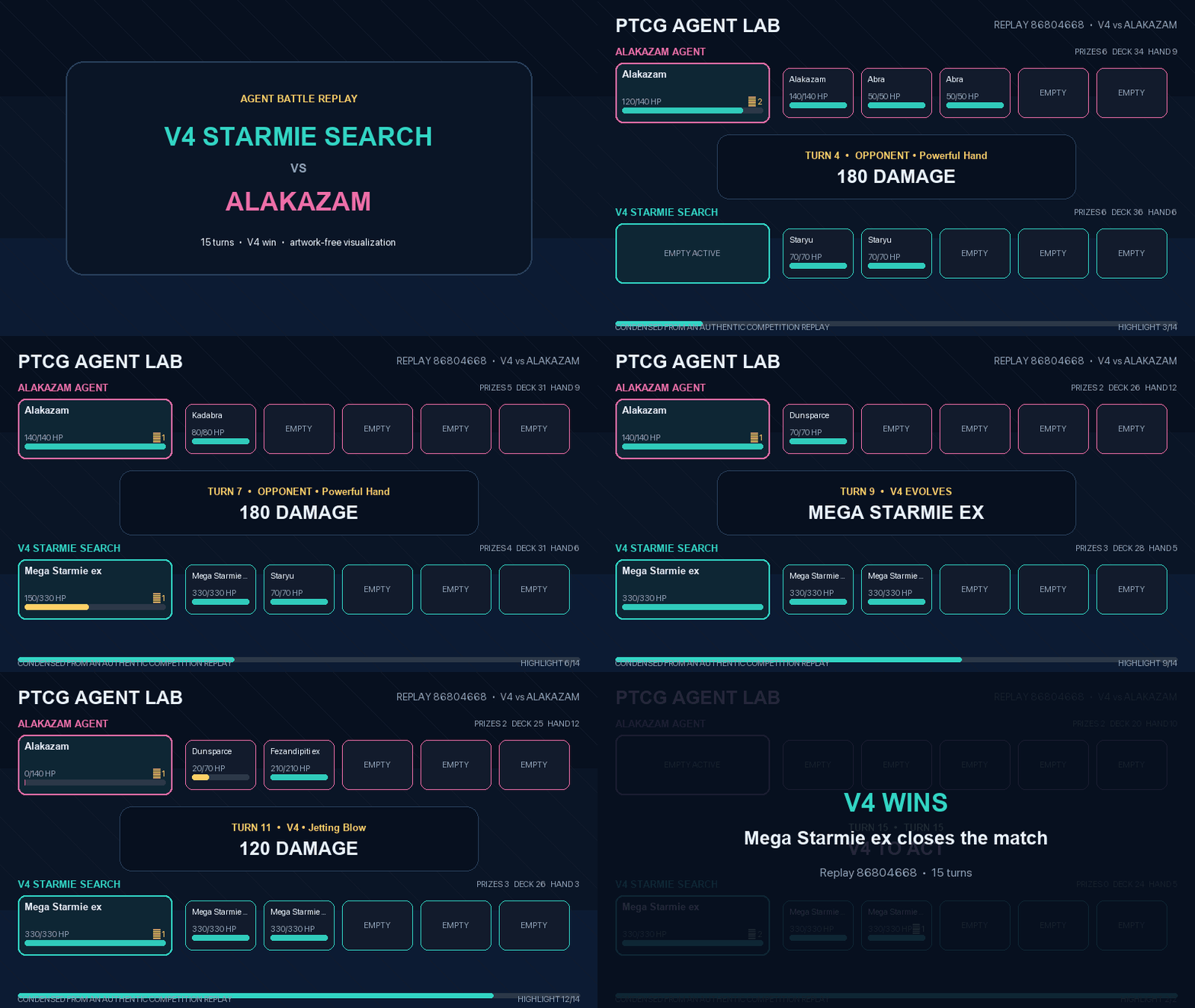
AUTHENTIC BATTLE REPLAY
Watch the policy recover under pressure.
An authentic 15-turn competition episode: V4 recovers from 90 of 330 HP to defeat an Alakazam agent. The replay is condensed to 26 seconds and rendered with abstract board panels.
APPROACH
I built an occurrence-weighted matchup catalog, seeded paired tests, and explicit promotion gates. The research branch evaluates every legal action counterfactually, rolls each branch toward an outcome, and trains a grouped ranker to compare actions only within the same decision state.
HOW IT WORKS
A system of connected decisions.
- 01A deterministic, deck-aware heuristic provides a stable fallback
- 02Replay-derived archetypes define the occurrence-weighted evaluation field
- 03Simulator branches label legal actions with terminal outcomes
- 04A LightGBM ranker scores alternatives within each decision root
DIFFICULT DECISION
The hardest decision was refusing attractive offline results. Replay imitation achieved strong held-out accuracy but failed complete games; a counterfactual Q policy improved weaker baselines but still lost heavily to V4, so neither replaced the proven fallback.
EVALUATION
Candidates face fresh seeded batches, aggregate win-rate gates, matchup-regression limits, and complete-game tests. The Q branch improved untouched winning-action selection from 60.3% to 70.9%, yet its failed V4 transfer was stopped at 121 wins versus V4’s 134 over 180 games.
RESULT